Industrial automation is undergoing a structural shift that two recent analyses make unmistakably clear.
Andreessen Horowitz’s The Electro-Industrial Stack Will Move the World positions motors and actuators as the essential “muscle” of the physical economy—the layer that converts electrical energy into precise motion and allows software to act in the real world.¹ Bain & Company’s Industrial Automation: From Control to Intelligence shows that value is simultaneously migrating away from traditional control systems toward the two ends of an hourglass: software/AI at the top and smart field devices (including actuators, drives, and motors) at the bottom.² Together, these perspectives define the new requirement: motors, actuators, and hydraulic presses must become not only more efficient and powerful, but capable of local decision-making.
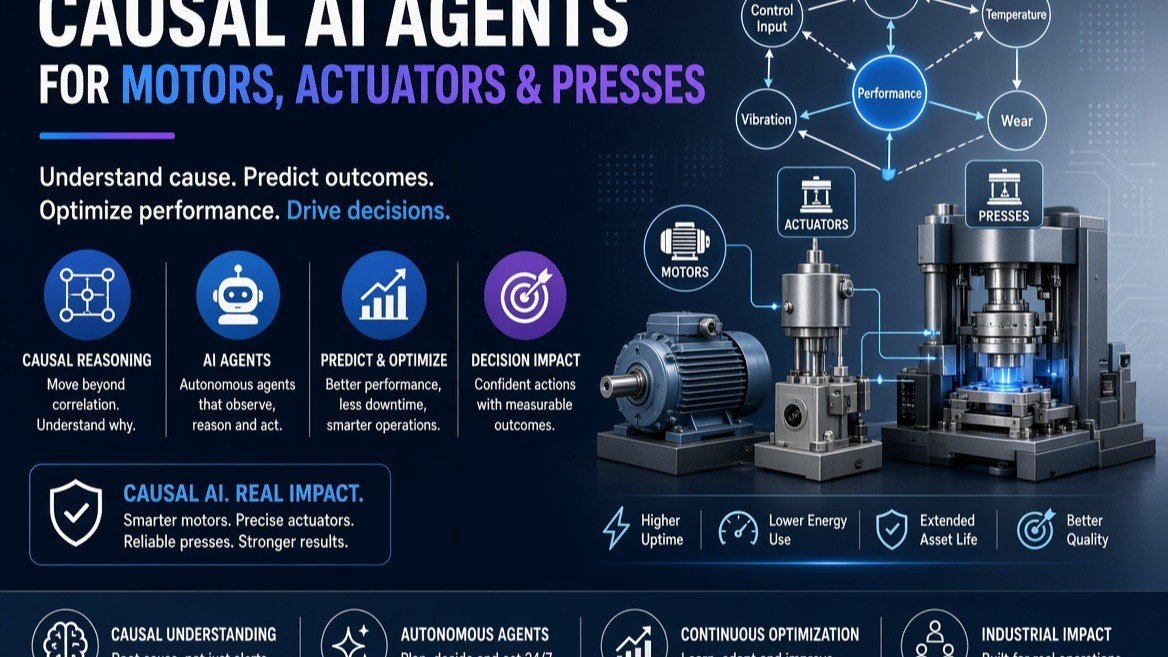
Intelligent Shopfloor (ISF) was built for exactly this transition. By embedding Causal AI into the shopfloor execution layer, ISF enables these machines to evaluate strategies, validate control parameters through counterfactual simulation, and act with explainable confidence.
Agents with a Causal AI Native Brain
ISF deploys machine-specific agents that run at the edge or within the shopfloor command center, remaining tightly coupled to the individual motor, servo drive, actuator, or hydraulic press they serve. Because each agent is bound to a particular machine, it continuously reasons over that machine’s own live signals, its unique historical behavior, and physics-informed models—rather than relying on generic assumptions drawn from fleet averages.
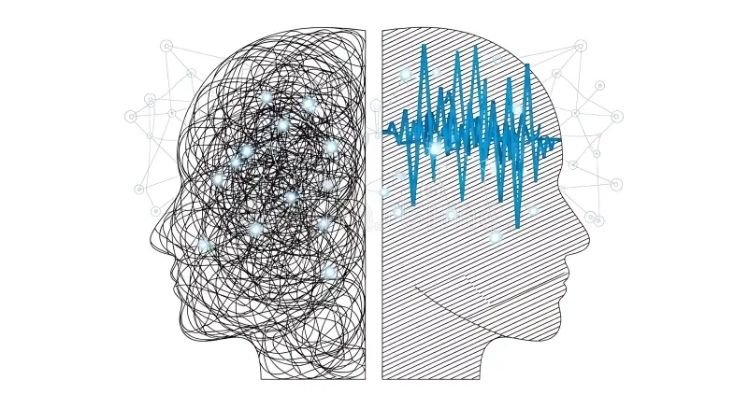
The foundation of this capability is the combination of physics AI and neurosymbolic AI. Physics AI supplies the governing equations and constraints of the mechanical and hydraulic system; neurosymbolic AI layers causal reasoning and symbolic decision structures on top. Together they individualize both the present state and the potential future behavior of each machine, allowing the agent to understand not only what is happening, but why it is happening and what would happen under alternative control strategies.
Instead of simply executing a pre-programmed control loop, the agent can ask:
- What is the true cause of the current deviation on this machine?
- If I change this parameter, what will the outcome be given this machine’s specific wear, temperature, and dynamic characteristics?
- Which strategy delivers the best result under the present conditions?
This moves the asset from rigid control logic to decision logic. The agent does not merely follow instructions; it evaluates alternative courses of action and selects the one with the highest confidence and operational impact.
The Power of Counterfactual and What-If Scenarios
The distinctive strength of ISF’s Causal AI is its ability to run fast, physics-informed counterfactual (what-if) simulations. Before a control parameter is changed or a new motion profile is executed, the agent tests the proposed action against a causal model that already incorporates the individual machine’s history and physics.
This validation step answers the critical question: “How good will this actually perform on this machine?”
Because the simulation is causal rather than purely statistical, the agent can explain why one strategy is preferred and quantify the expected improvement in energy use, cycle time, wear, or quality.
Example 1: Servo Motor on a High-Speed Packaging Line
A servo motor driving a packaging conveyor begins to show rising torque ripple and slight position overshoot at higher speeds. Traditional control would either ignore the issue or apply a fixed gain adjustment.
With an ISF Causal AI agent (running at the edge or shopfloor command center and bound to this specific motor):
- The agent detects the emerging pattern and identifies the causal drivers unique to this motor (temperature rise in the windings + slight mechanical backlash growth observed in its own history).
- It runs three what-if scenarios in milliseconds.
- Counterfactual results show Scenario B reduces peak torque by 19 %, lowers winding temperature rise by 7 °C, and keeps throughput within 0.4 % of target—while Scenario A increases thermal stress on this particular motor.
- The agent selects and executes Scenario B, continuously monitoring the outcome and updating its machine-specific causal model.
The motor is no longer just executing motion. It is actively choosing the strategy that balances performance, longevity, and energy efficiency for its own physical state.
Example 2: Hydraulic Press in Forming Operations
A hydraulic press used for precision forming exhibits occasional force overshoot and longer-than-expected dwell times, leading to part variation and higher energy consumption.
The ISF agent (tied to this individual press):
- Continuously tracks pressure, valve response, temperature, and force feedback specific to this machine.
- Detects a causal chain linking oil viscosity change, valve hysteresis, and slight seal wear that is unique to this press’s operating history.
- Runs what-if simulations for the next cycle.
- Simulation shows that the combination of Scenarios B + C reduces force overshoot by 23%, cuts energy per cycle by 11%, and brings dimensional variation inside specification with higher confidence.
- The agent applies the validated parameter set and monitors the actual result against the predicted outcome, closing the learning loop for this specific press.
The press is no longer a powerful but reactive machine. It evaluates control strategies, validates them through counterfactuals grounded in its own physics and history, and executes the one that delivers the best process outcome.
The Unique Software–CPU–NPU–MCU Platform for On-Shopfloor Causal Inference
Delivering this capability requires more than cloud AI or traditional edge controllers. ISF runs on a purpose-built software–CPU–NPU–MCU architecture designed for Causal AI native inference at the machine level:
- MCU layer: Deterministic, low-latency control loops and safety functions remain on the microcontroller for hard real-time performance and functional safety.
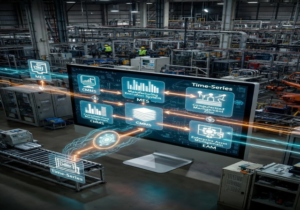
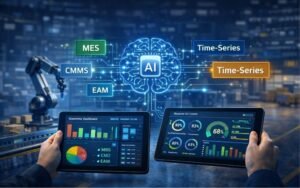
- CPU layer: Handles orchestration, data fusion from multiple sensors, and coordination with higher-level systems (MES, WMS, or plant agents).
- NPU layer: Accelerates the Causal AI models and physics-informed simulations, enabling fast what-if evaluation without leaving the machine or the shopfloor command center.
- Software layer: The ISF Causal Runtime provides the native brain—causal graph reasoning, counterfactual engine, and explainable decision output—tightly integrated across the hardware stack and individualized to each machine through the combination of physics AI and neurosymbolic AI.
This design allows Causal AI inference to occur locally, with millisecond-to-second response times, full explainability, and no dependency on continuous cloud connectivity. The result is intelligence that lives where the physics happens—on the motor, the actuator, and the hydraulic press.
The Outcome
When motors, actuators, and hydraulic presses are equipped with machine-specific Causal AI agents capable of strategy evaluation and what-if validation, three things change:
- Machines stop being pure executors and become decision participants whose reasoning is grounded in their own physical reality.
- Control parameters are no longer set by trial and error or fixed recipes; they are tested against individualized causal models before execution.
- Performance, energy efficiency, quality, and asset life improve simultaneously because every action is chosen with foresight specific to that machine.
The industry direction articulated by a16z and Bain is clear: intelligence is moving to the field devices, and the physical layer must become both more capable and more intelligent. Intelligent Shopfloor provides the Causal AI native platform that lets motors, actuators, and hydraulic presses not only become smarter and more powerful—but capable of deciding, validating, and executing the best strategy on the shopfloor itself.
The machines are ready to think. ISF gives each one a brain that understands its own physics and history.
Visit https://intelligentshopfloor.com
References
- Andreessen Horowitz, “The Electro-Industrial Stack Will Move the World,” a16z.com.
- Michael Schertler, Neil Malik, Adrien Bron, Scott Duncan, and Mike Coxon, “Industrial Automation: From Control to Intelligence,” Bain & Company, April 7, 2026.
#CausalAI #IndustrialAI #SmartManufacturing #Motors #Actuators #HydraulicPress #EdgeAI #ShopfloorAI #DeterministicAI #PhysicsAI
Originally posted on LinkedIn: https://www.linkedin.com/pulse/from-control-decision-how-intelligent-shopfloor-turns-sanjay-mazumder-hut0c