Company Background
A leading injection molding company with over 20 facilities across the United States, employing thousands and operating hundreds of injection presses. Specializing in plastic containers and components for industries such as beverages, food, consumer goods, chemicals, and automotive, the company processes resins like HDPE, PET, PP, and PVC. With a focus on sustainability through lightweighting, recycled materials, and energy-efficient upgrades, it has achieved annual growth surpassing industry averages. However, rapid expansion and reliance on diverse machine platforms have led to persistent challenges in maintaining consistent product quality.
Challenges Faced
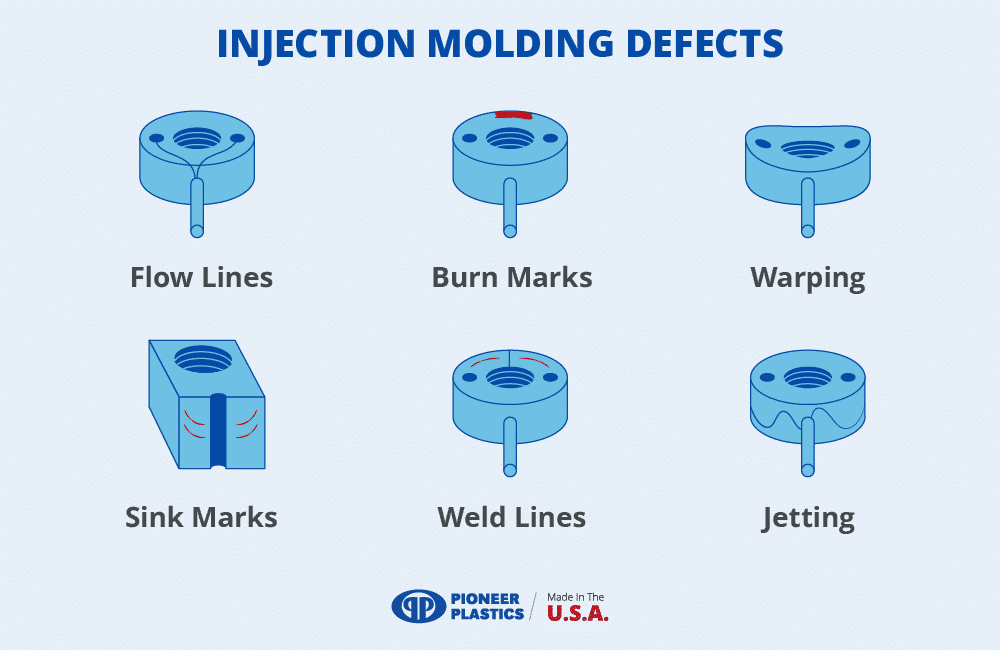
In injection molding, quality defects can significantly impact production efficiency, customer satisfaction, and profitability. The company experienced recurring issues such as warping, sink marks, flash, and uneven wall thickness, often resulting from complex interactions between process variables like melt temperature, injection pressure, cooling time, and material contamination. Traditional troubleshooting relied on correlations and manual root cause analysis (RCA), which only addressed symptoms—leading to downtime, scrap rates exceeding 5%, and difficulties in scaling optimizations across plants. For instance, warping often stemmed from insufficient cooling or uneven material flow, but identifying the precise causal relationships was time-consuming and prone to error, especially with recycled resins introducing variability.
Common defects included:
- Warping: Distortion of parts due to uneven cooling or residual stresses.
- Sink Marks: Depressions on the surface caused by inadequate packing pressure or thick sections cooling unevenly.
- Flash: Excess material leaking from the mold due to high injection pressure or worn clamps.
These issues were exacerbated by equipment downtime from aging machines and supply chain disruptions, making it hard to move beyond reactive fixes to proactive prevention.
Solution: Implementing Intelligent Shopfloor’s Product Line
To address these challenges, the company adopted Intelligent Shopfloor’s modular suite of Deterministic Industrial AI solutions, built on causal, cognitive, and content agent orchestration. This approach enabled modeling of relationships between process variables and outcomes, uncovering true causes rather than mere correlations.
Foundation: Shopfloor Orchestrator
As the core platform, the Shopfloor Orchestrator provided zero-copy data federation, seamlessly integrating real-time data from OT/IT sources like PLCs, SCADA, MES, CMMS, and ERP systems without invasive data warehouses. This reduced deployment time to days and ensured edge governance for low-latency insights. It served as the “anti-warehouse” backbone, allowing intent-based orchestration across multi-channel interfaces (text, voice, AR/VR) to capture tribal knowledge and automate workflows.
Core Analysis: Causal Insight Agent
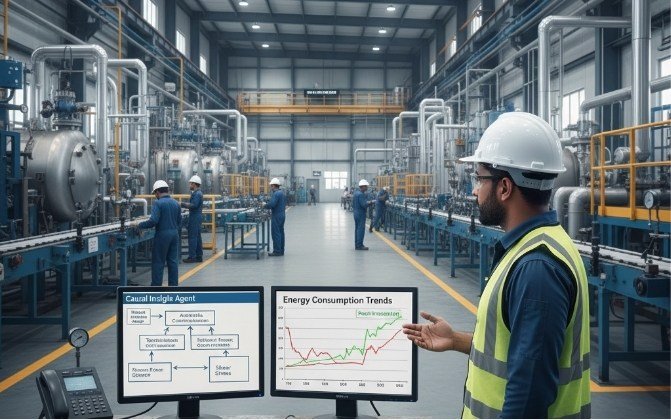
At the asset level, the Causal Insight Agent was deployed to perform causal analysis on time-series data from injection presses. Using causal graphs, it modeled relationships between variables such as temperature, pressure, cycle time, and defect rates. For example, it identified that sink marks were not just correlated with cooling time but causally driven by interactions between high melt temperature and low packing pressure, especially in thicker part sections. This uncovered root causes like material shrinkage variations from recycled content, prescribing actions such as automated adjustments to CMMS work orders for mold maintenance.
By leveraging physics-informed diagnostics, the agent forecasted failure timelines and integrated outputs for prescriptive fixes, surpassing traditional tools that rely on probabilistic correlations.
Advanced Simulation: Causal Simulator
Building on the Insight Agent, the Causal Simulator enabled “what-if” scenarios with physics-based constraints from equipment manuals. It ran counterfactual simulations to predict outcomes without disrupting production—for instance, testing how reducing injection speed by 10% could mitigate flash defects while maintaining cycle times. This deterministic precision replaced conventional digital twins, allowing optimization of energy efficiency and process parameters in variable environments.
Plant-Wide Scaling: Plant Insight Agent
For enterprise-level coordination, the Plant Insight Agent interconnected asset models across facilities, executing system-wide simulations and prescriptive workflows. It captured interconnected relationships, such as how resin supply variability at one plant affected downstream quality, enabling multi-asset optimization for continuous improvement and sustainability.
The underlying technology—a combination of Causal Engine (analytical logic for “why”), Knowledge Engine (contextual wisdom for “how”), and deterministic AI—delivered high-certainty insights with low friction, positioning the solution in the top-right quadrant for decision-making.
Implementation Process
Deployment began with the Shopfloor Orchestrator integrating data from existing systems in a pilot plant. The Causal Insight Agent was then applied to high-defect lines, building causal graphs from historical and real-time data. Simulations via the Causal Simulator tested interventions, and the Plant Insight Agent scaled learning enterprise-wide. Training involved minimal disruption, with agents capturing operator expertise for ongoing refinement. The total rollout took under two months, compared with traditional systems that require extensive warehousing.
Results and Benefits
Post-implementation, the company achieved:
- Defect Reduction: Scrap rates dropped by 40% through precise RCA, with causal models identifying drivers like pressure deviations causing 60% of warping issues.
- Downtime Minimization: Predictive prescriptions reduced unplanned stops by 25%, shifting production seamlessly across plants during disruptions.
- Efficiency Gains: Optimized parameters boosted throughput by 15%, with lightweighting and resin conversions enhanced by simulation-driven insights.
- Sustainability Improvements: Better control over variables lowered energy use by 10% and increased recycled material incorporation without quality trade-offs.
- ROI: The non-invasive approach delivered value in weeks, outperforming competitors’ high-friction platforms.
By moving beyond symptoms to root cause, Intelligent Shopfloor enabled the company to take deterministic actions, ensuring resilient, high-quality injection molding operations.
Ready to transform your manufacturing? Contact Intelligent Shopfloor at info@intelligentshopfloor.com or schedule a demo.