In our ongoing series, we’ve discussed data silos and AI’s role in unlocking value. Now, let’s explore the next frontier: moving beyond mere prediction to true decision intelligence, where AI not only forecasts but empowers actionable, explainable choices.

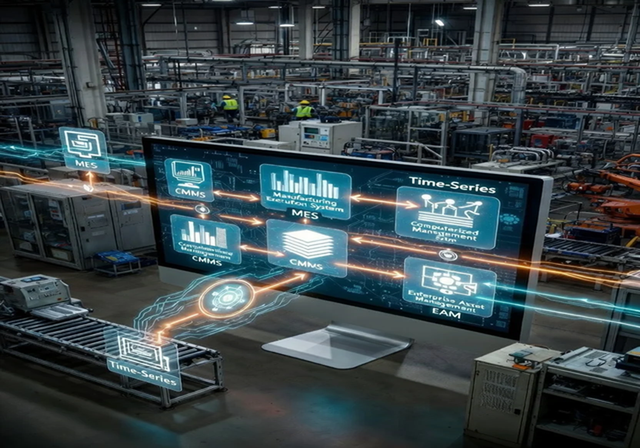
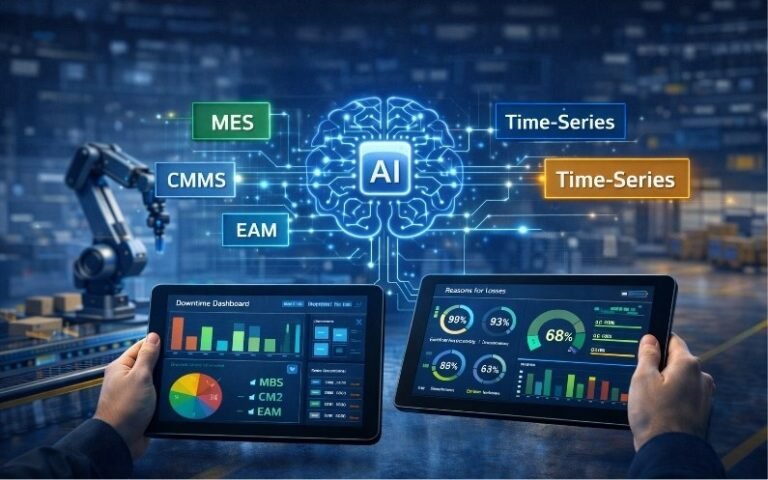
Predictive analytics has helped manufacturers anticipate failures or forecast outcomes. Tools like Prophet for time-series forecasting or scikit-learn’s Random Forest for anomaly detection have reduced downtime by predicting issues based on patterns in MES, CMMS, EAM, and time-series data. However, prediction alone does not explain why something is likely to happen or how different actions may change the result. It’s like knowing a storm is coming but not understanding its causes or how to mitigate damage effectively.
Advanced AI—especially causal and decision-focused approaches—helps teams reason about cause-and-effect relationships. Leveraging frameworks like DoWhy for causal inference or Pyro for probabilistic programming, these methods integrate data from disparate sources to model interventions. For instance, using directed acyclic graphs (DAGs) in Bayesian networks (via pgmpy library), AI can simulate “what-if” scenarios compliant with ISA-95 standards for production control.
This allows manufacturing teams to:
- Diagnose the true drivers behind downtime, quality loss, or inefficiency: Traditional root-cause analysis (RCA) relies on methods like 5 Whys, but AI scales this with counterfactual reasoning. By analyzing time-series data from OSIsoft PI alongside CMMS logs, causal models identify if vibration spikes (measured via ISO 10816) cause bearing failures, not just correlate with them, reducing diagnostic time from days to minutes.
- Evaluate alternative actions before implementing changes: Decision-focused AI uses optimization techniques like linear programming in PuLP or reinforcement learning in Gym environments to test strategies. In a high-variability auto assembly line, it might simulate adjusting spindle speeds via SCADA inputs, predicting impacts on OEE while considering constraints from EAM asset health.
- Understand trade-offs between cost, risk, and throughput: Multi-objective optimization with libraries like DEAP evaluates Pareto fronts—balancing maintenance costs (from CMMS) against production throughput (from MES). This ensures decisions align with business KPIs, such as minimizing MTTR while maximizing yield under IEC 62443 security protocols.
- Make decisions that are explainable and defensible: Unlike black-box models, explainable AI (XAI) techniques like SHAP values provide feature importance, making outputs auditable for regulatory compliance (e.g., FDA 21 CFR Part 11 in pharma manufacturing). This builds trust, turning AI from a tool into a collaborative partner.
This shift—from prediction to decision intelligence—is critical for complex, high-variability manufacturing environments. In volatile markets with supply chain disruptions, predictive models fall short; decision AI adapts dynamically. Gartner predicts that by 2025, 75% of enterprises will shift to operational AI with causal capabilities, driving 20-30% efficiency gains.
Consider a real case: A chemical plant using Intelligent Shopfloor’s platform applied causal AI to EAM and time-series data, revealing that humidity fluctuations—not just machine age—accounted for 15% of quality defects. By evaluating interventions, they optimized HVAC controls, cutting waste by 18% and saving $500K annually.
The business imperative is clear: In Industry 4.0, decision intelligence turns data into competitive advantage, fostering agility and resilience. At Intelligent Shopfloor, we’re pioneering this with scalable, edge-to-cloud architectures.