Company Background
A leading global specialty chemicals manufacturer operates over 27 production sites worldwide, employing around 16,000 people and generating annual sales of €6-8 billion. Specializing in silicones, polymers, polysilicon, and biotechnology products, the company serves industries including electronics, construction, automotive, and pharmaceuticals. Key processes include energy-intensive operations like plasma-enhanced chemical vapor deposition (PECVD) for insulation layers in chip manufacturing, where wafers are heated to 500–1,200°C, and polysilicon production for solar panels, which involves high-purity requirements and significant energy use. The manufacturer is committed to sustainability, aiming for net-zero emissions by 2045, a 50% reduction in absolute greenhouse gas (GHG) emissions by 2030 relative to 2020, and a 15% cut in specific energy consumption by 2030. Initiatives include life cycle assessments, energy-efficiency measures via the company’s operating system, and innovations like replacing fossil fuels with biogenic agents in silicon production.
Challenges Faced
In specialty chemicals manufacturing, energy management is critical due to high-intensity processes that contribute to GHG emissions and environmental impact. The company faced challenges in optimizing energy use while maintaining quality and compliance. For instance, PECVD processes require precise control of variables like temperature and silane flow to minimize volatile organic compound (VOC) emissions and ensure defect-free outputs, but siloed data from PLCs, SCADA, and IIoT sensors led to reactive adjustments, alert fatigue, and suboptimal efficiency. Polysilicon production, affected by market volatility and excess capacity, demanded cost discipline amid high energy demands from natural gas and electricity (e.g., 5,749 GWh electricity consumption in 2023). Broader issues included reducing upstream emissions by 25% by 2030 and implementing annual energy savings of 1.5% through measures like heat recovery and combined heat and power (CHP) plants. Without causal insights, process changes risked downstream effects like increased defects or higher emissions, hindering confident decision-making for sustainability goals.

Solution: Implementing Intelligent Shopfloor’s Product Line
To enhance energy management, the manufacturer deployed Intelligent Shopfloor’s Deterministic Industrial AI suite, leveraging Causal, Cognitive, and Content Agent Orchestration. This enabled causal reasoning to compare process alternatives, anticipate downstream effects, and support confident decisions for sustainable optimizations.
Foundation: Shopfloor Orchestrator
The Shopfloor Orchestrator established zero-copy data federation, integrating real-time OT data from PLCs and SCADA (e.g., temperature, flow rates) with IT systems like CMMS and ERP. It facilitated edge governance for low-latency orchestration, capturing unstructured sources like equipment manuals for contextual energy analysis in PECVD and polysilicon lines.
Core Analysis: Causal Insight Agent
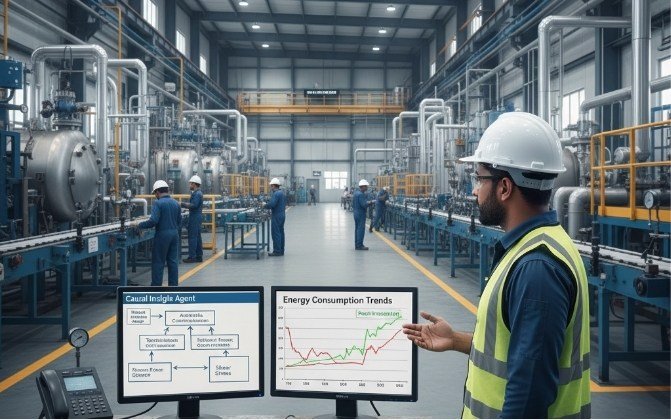
The Causal Insight Agent performed asset-level causal analysis on time-series data, modeling relationships such as temperature variations causally impacting energy consumption and VOC emissions. It uncovered root causes, like inefficient silane flow leading to excess heat requirements, providing “why” diagnostics to prioritize energy-saving interventions.
Advanced Simulation: Causal Simulator
Key to the solution, the Causal Simulator conducted physics-informed “what-if” simulations with constraints from process manuals. It compared alternatives, such as adjusting silane flow by 10% versus electrifying steam generation, anticipating downstream effects like a 20% energy reduction but potential 5% increase in deposition defects if not balanced. Counterfactuals forecasted outcomes, enabling confident decisions—e.g., simulating biogenic reducing agents in polysilicon production predicted a 15% GHG cut without compromising purity, aligning with net-zero goals.
Plant-Wide Scaling: Plant Insight Agent
The Plant Insight Agent interconnected models across facilities, executing plant-scale simulations and prescriptive workflows. It captured cross-variable impacts, like how PECVD optimizations affected overall site emissions, and retained knowledge for scalable sustainability, such as annual efficiency measures reducing 27,000 MWh/year.
Through causal reasoning, the orchestration allowed pre-implementation assessments, ensuring decisions minimized environmental impact while boosting efficiency.
An example simulated causal graph for energy optimization in PECVD:
Implementation Process
Implementation started with the Shopfloor Orchestrator federating data at a pilot polysilicon site. The Causal Insight Agent built graphs from historical energy data, followed by Causal Simulator tests of alternatives using VAR models for predictions. The Plant Insight Agent scaled validated changes group-wide, incorporating multi-channel feedback. Rollout took weeks, with edge deployment ensuring compliance and minimal disruption.
Results and Benefits
Post-implementation, the manufacturer achieved:
- Energy Reduction: 30% cut in specific diagnostics energy, with simulations enabling 1.5% annual savings and 11 kt CO2e annual reductions from actions like adsorber stations.
- Emission Mitigation: Anticipated downstream effects reduced VOCs by 25%, supporting 50% GHG cuts by 2030.
- Efficiency Gains: Compared alternatives avoided inefficient changes, boosting process yields by 15% in PECVD.
- Sustainability Advancements: Confident decisions via causal reasoning accelerated net-zero progress, earning top CDP ratings (A in Climate).
- ROI: Non-invasive approach delivered rapid value, outperforming correlation-based tools.
By using causal reasoning, Intelligent Shopfloor transformed energy management into a proactive, sustainable strategy.
Ready to advance your sustainability? Contact Intelligent Shopfloor at info@intelligentshopfloor.com or schedule a demo.