Company Background
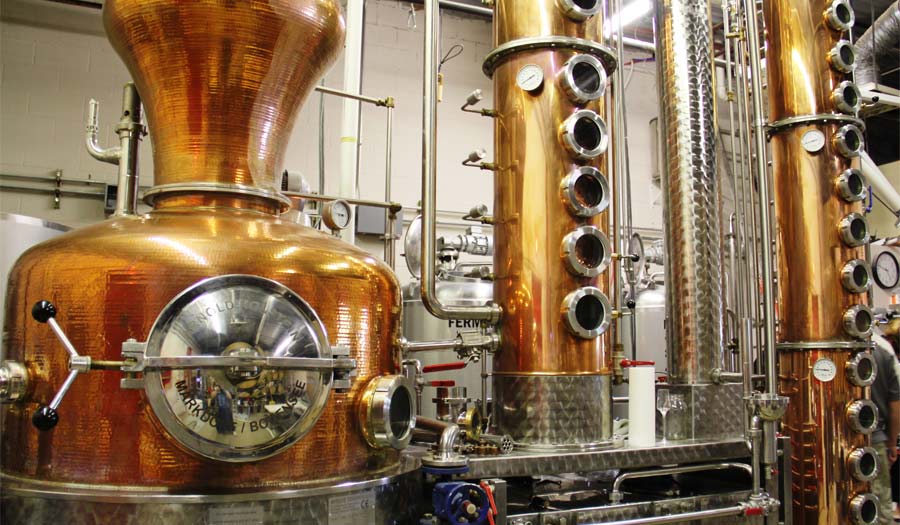
A mid-sized craft distillery located in Milwaukee, Wisconsin, specializes in producing premium spirits, including whiskey, gin, and vodka. Operating in a historic building, the distillery handles in-house production from grain to bottle, with a capacity for aging and bottling thousands of cases annually. The whiskey production process involves key steps: malting barley to convert starches to sugars, mashing the grist with hot water in mash tuns to extract fermentable wort, fermenting with yeast in washbacks to create alcoholic wash, distilling in copper pot stills (typically twice) to refine the spirit, maturing in oak barrels for flavor development, and finally bottling. While the distillery prides itself on artisanal methods, rapid growth and market demands have prompted considerations for process optimizations, such as adjusting fermentation times or mashing temperatures to improve yield and flavor profiles.
Challenges Faced
In craft distilling, process changes can enhance product quality or efficiency but often carry risks of unintended downstream effects. The distillery faced challenges in evaluating modifications without disrupting operations. For instance, extending fermentation duration might boost alcohol yield but could alter flavor compounds, impacting distillation efficiency or maturation outcomes like unwanted off-notes or reduced aging potential. Traditional methods relied on trial-and-error runs, leading to wasted batches, increased costs, and delayed market responses. Siloed data from PLCs controlling stills, temperature sensors in mash tuns, and manual logs from fermentation exacerbated this, making it hard to anticipate cascading effects like over-fermentation causing excessive fusel oils or temperature shifts affecting yeast performance. Consequences included inconsistent quality, higher scrap rates, and hesitation in innovating recipes amid competitive pressures.
Common issues included:
- Flavor Variability: Changes in mashing could unpredictably affect wort composition, leading to inconsistent fermentation.
- Yield Fluctuations: Altering distillation parameters risked lower alcohol recovery or equipment strain.
- Downstream Risks: Modifications might propagate to maturation, delaying product release or compromising taste.
These challenges highlighted the need for a system to assess impacts preemptively, compare options, and ensure confident decisions.
Solution: Implementing Intelligent Shopfloor’s Product Line
To enable robust decision support, the distillery adopted Intelligent Shopfloor’s modular Deterministic Industrial AI solutions, built on Causal, Cognitive, and Content Agent Orchestration. This facilitated causal reasoning to evaluate process changes, simulating alternatives and forecasting downstream effects without real-world trials.
Foundation: Shopfloor Orchestrator
The Shopfloor Orchestrator provided the core for zero-copy data federation, integrating real-time OT data from PLCs, SCADA (e.g., still temperatures, fermentation pH), and IT systems like CMMS for maintenance and ERP for inventory. It ensured edge governance and multi-channel interfaces (text, voice, AR) to capture operator insights, forming a non-invasive backbone for orchestration.
Core Analysis: Causal Insight Agent
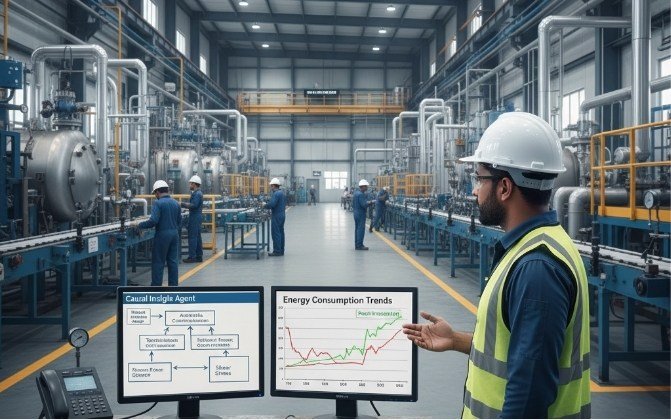
At the asset level, the Causal Insight Agent modeled causal relationships using graphs on time-series data. It identified links like mashing temperature influencing wort gravity, which causally affected fermentation speed and spirit quality. This uncovered root drivers, such as how a 2°C increase in mashing could boost sugars but risk enzyme denaturation, providing “why” insights for initial change assessments.
Advanced Simulation: Causal Simulator
Central to the solution, the Causal Simulator ran physics-informed “what-if” scenarios with constraints from equipment manuals (e.g., still capacities, barrel aging dynamics). It compared alternatives, such as shortening fermentation by 12 hours versus introducing a new yeast strain, anticipating effects like a 15% yield gain but 10% flavor dilution risk. Counterfactual simulations predicted downstream impacts, like reduced maturation time or quality shifts, enabling confident decisions without production halts.
Plant-Wide Scaling: Plant Insight Agent
The Plant Insight Agent extended simulations plant-wide, interconnecting processes from mashing to bottling. It prescribed workflows, capturing tribal knowledge for scalable changes, and ensured optimizations aligned with overall throughput and sustainability goals.
The orchestration delivered deterministic outcomes, allowing the distillery to assess changes pre-implementation, compare scenarios, and anticipate effects via causal reasoning.
An example of a simulated causal graph for process change evaluation:
Implementation Process
Deployment began with the Shopfloor Orchestrator federating data in a pilot fermentation line. The Causal Insight Agent built baseline models, followed by Causal Simulator tests of hypothetical changes using historical data. The Plant Insight Agent scaled validated scenarios enterprise-wide. Minimal disruption occurred, with rollout in weeks, incorporating operator feedback via voice interfaces for refinement.
Results and Benefits
Post-implementation, the distillery achieved:
- Informed Changes: Simulated a fermentation tweak, predicting a 20% yield increase with minimal flavor impact, implemented confidently.
- Risk Mitigation: Compared alternatives, avoiding a mashing adjustment that would have caused 25% downstream distillation inefficiencies.
- Efficiency Gains: Reduced trial batches by 50%, cutting costs and accelerating innovations.
- Quality Improvements: Anticipated effects ensured consistent maturation, boosting product ratings.
- ROI: Low-friction approach delivered value rapidly, outperforming probabilistic tools.
By leveraging causal reasoning, Intelligent Shopfloor empowered proactive decision-making, transforming process changes from risks to opportunities.
Ready to optimize your processes? Contact Intelligent Shopfloor at info@intelligentshopfloor.com or schedule a demo.