
In early 2025, I had great data.
I was doing product engineering for AI-native startups. One of them had given me years of real-world periodontal patient records: treatment histories, medication lists, general medical records, dental X-rays, periocharts, onboarding data, and even COVID-19 screenings.
My task was straightforward: They wanted me to build a model that could predict who would have periodontal problems, so they could treat them before they happened.
Despite having great data, the standard correlational approaches I was using weren’t working. By digging into the outcomes data, I could see that my models were relying on historical data and confidently forecasting “stable” outcomes for patients who were actually about to have significant mouth problems, including rapid bone deterioration.
Periodontal health is characterized by a complex, non-linear interplay of systemic, behavioral, and local determinants. For example, stress does not merely correlate with bone loss. Rather, stressed-out patients grind their teeth, which changes the medications that they take, which interacts with their genetic predisposition, which ultimately influences how well they take care of their teeth. Conventional models identify co-occurrences, but cannot delineate the underlying causal mechanisms.
Worse, conventional models can fall into what I now call the Prediction Trap. You can achieve 90 %+ accuracy on historical data and still give dangerously wrong clinical advice because you never understood why things happen.
One of the discoveries was the phenomenon of deceptive indicators. Clinical textbooks treat Bleeding on Probing (BOP) as a gold-standard marker. This happens when your dentist gently probes the pocket in your gum, which triggers bleeding.
But in 60% of the cases I analyzed, patients showed 0% BOP while deep pockets and active bone loss raged beneath. Why? Smoking, steroids, and calcium channel blockers. These factors can block bleeding and quietly mask the inflammatory signals that periodontists use to detect bleeding beneath the surface.
Here’s the table that stopped me in my tracks and forced me to rethink everything:
| Causal Failure Category | Clinical Manifestation | Impact on Prediction |
| Deceptive Indicators | Low BOP (0%) in smokers with deep pockets.¹ | False negative; predicted stability despite active disease. |
| Mediated Risks | Systemic stress causes bruxism, leading to fractures.¹ | Missed root cause; treating the symptom rather than the source. |
| Temporal Confounding | Long maintenance lapses precede sudden failure.¹ | Inability to weigh the “chronological gap” as a primary risk. |
| Iatrogenic Effects | Medication-induced gingival hypertrophy masking pocket depth.¹ | Distorted measurements leading to incorrect prognosis. |
| Systemic Overload | Multiple Myeloma treatments affect healing capacity.¹ | Failure to adjust risk based on “healing potential” rather than “current state.” |
These weren’t edge cases. There were rules.
I realized the data wasn’t just multi-modal. It was a trajectory.
A patient’s state at time t is both the consequence of everything that came before and the cause of everything that follows. Correlation-based models look at snapshots. They miss the sequence: unmanaged tooth grinding leads to a vertical root fracture, which leads to tooth loss.
I noticed that patients usually fall into two main groups: those whose problems are mechanical (bite-related) and those whose problems are biological (body-wide). Seeing these as separate patterns was more useful than looking at individual symptoms, but I still needed a deeper scientific explanation for why they exist. I needed a causal theory.
This exploration led me to a thorough review of recent publications from the Stanford Causal Science and AI Research Lab. The laboratory’s contribution, specifically Double/Debiased Machine Learning (DML) and Neyman Orthogonality, provided the initial crucial methodology.
The data I used were high-dimensional. It included images (X-rays), electronic health records, periodontal charting measurements, and medication histories. In such datasets, regularization bias is a prevalent issue. While we use regularization to help the model ignore noise, it often systematically underestimates the impact of real clinical risks, ‘shrinking’ important signals until the model loses its ability to see the true causal drivers of the disease.
Deep neural networks, for example, readily incorporate available yet irrelevant patterns. DML facilitates the use of these robust black-box learners for “nuisance parameters” (such as age and demographics) while preserving the integrity and unbiasedness of the true treatment effect estimation.
Next came Proximal Causal Inference. As a data scientist, I am used to simply looking at the data. However, in this case, many of the critical factors were not in my data! True systemic inflammation, clinician bias in charting, and the patient’s actual home-care compliance: all of these are important but not explicitly written down anywhere. Stanford’s proximal methods use “proxies”: COVID screening data, onboarding paperwork, etc. Using these proxies helps us see what is not in our dataset. We may not exactly record that a patient is “stressed,” but we can see that they are not updating their medication list and infer that things in their life are a little out of control.
A proximal model correctly up-weights risk for a patient whose low BOP was actually medication-induced masking. The AI wasn’t just correlating symptoms. It was reasoning about what was really happening underneath.
Then Causal Representation Learning. The periochart wasn’t just numbers anymore; it became a map of the “Gingival Micro-environment.” X-ray morphology became “Bone Morphology” and “Furcation Defect Severity.” We could now simulate counterfactuals: “What would the bone level be if this patient had been prescribed a different cardiovascular medication?”
The most beautiful adaptation was Dynamic Treatment Regimes (DTR). Periodontal care is inherently sequential: diagnosis → non-surgical therapy → re-evaluation → maintenance or surgery. Stanford’s DTR framework lets me model the entire patient journey as a trajectory where the value of each treatment depends on everything that came before.
I mapped this directly onto the McGuire & Nunn 5-tier classification system. The AI became self-correcting, updating prognosis in real time as new periocharts or HbA1c values arrived.
Here is a cleaned-up version of the table I wrote on my whiteboard:
| Stanford Causal AI Concept | Periodontal Risk Application | Mechanism of Action |
| Double/Debiased ML (DML) | Removing bias from high-dimensional X-ray data.⁴ | Neyman Orthogonality for unbiased estimates. |
| Proximal Causal Inference | Accounting for unobserved systemic inflammation.⁴ | Disentangling clinician bias from biological markers. |
| Heterogeneous Treatment Effects | Personalizing prognosis for specific patient “archetypes”.⁴ | Estimating varied effects across patient subgroups. |
| Riesz Regression / RieszNet | Automating the discovery of risk weights in messy EHR data.⁴ | Identifying optimal policy values for clinical intervention. |
| Sensitivity Analysis | Quantifying the impact of missing medication history.⁴ | Providing statistical guarantees in high-uncertainty cases. |
The transformation was profound. What had been a black-box predictor became a transparent co-pilot that could explain why it changed a prognosis from “Good” to “Questionable” when a new systemic factor appeared. We could identify patients who needed care before things got out of control.
I started sharing early results with the periodontists who had provided the data. Their feedback was electric. One senior clinician told me, “This isn’t just predicting. It’s thinking as we do, but without the fatigue or bias.”
That was the moment I knew the approach was universal.
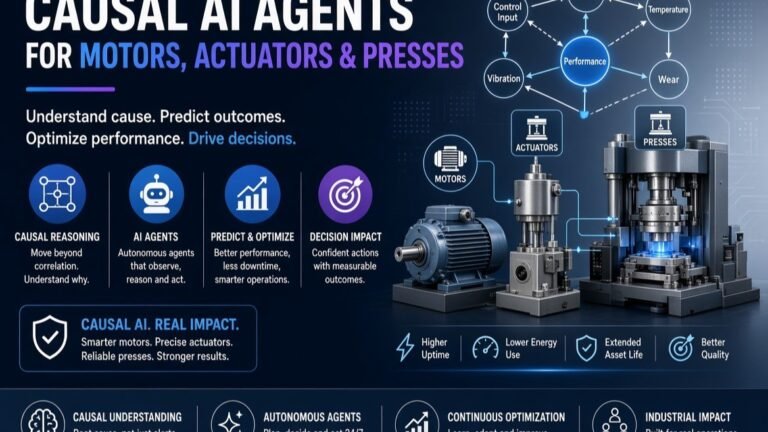
My good friend Ashis had already started talking to me about the promise of smart manufacturing, and I began wondering whether this approach could be applied there.
If the same causal structures governed both a patient’s gingival health trajectory and a stamping press’s operational trajectory, then the manufacturing world, plagued by the exact same Prediction Trap in predictive maintenance, was waiting for this.
I began thinking back to my training as a pure electrical engineer, and began sketching the parallels. Latent Inflammatory State became Latent Asset Health. Dynamic Treatment Regimes became Dynamic Control Regimes. The chronological monitoring pipeline I built for dental patients served as the blueprint for real-time root-cause analysis on the shop floor.
The conviction grew so strong that we planned to pivot to the Intelligent Shopfloor. Consequently, the time had arrived to apply this acquired knowledge toward the development of the deterministic platform so critically required by the manufacturing sector.
That story is next.
And if you’re an AI practitioner or manufacturing leader tired of models that predict but cannot prescribe, the platform that grew directly out of these late-night Stanford sessions is ready for you at https://intelligentshopfloor.com.
-Sanjay Mazumder
CTO, Intelligent Shopfloor